Posts

Showing posts with the label cyberspace

Don't Be Such A Downer.

I've been told that I am a negative person. And of course, I don't think I am. My motivated reasoning kicks in and immediately tells me that I can't be that negative . But then I stop to think about it and realize that I might be,  after all . Always looking at the phone for the news-break --which are generally negative. Sharing the latest story about a potential pandemic , or about locust swarms blanketing africa , or about the potential WWIII-triggering assassination of an Iranian Commander . Or about the Puerto Rico earth-quake . Reflecting upon that, I've settled upon a couple of ideas. Yes, I pay more attention to the negative stuff. And I share it as soon as I can (at least the significant parts). But I don't think that makes me negative . I think that makes me human. I am, just like everyone else, equipped with a bunch of mental quirks that make me (and you) gravitate towards anything threatening around you. When we are reminded of all the progress that ...

Emotional Times

Image
It recently dawned on me that Governments no longer govern people. They govern opinions. These days, people don't vote. Emotions do. Yes, a hand might ultimately pull the lever at the ballot box, but it is the emotion inside that voter's heart which sets in motion the wheels of any electoral backlash. Maybe there was once a Utopian time (I can't quite pinpoint it; go ask a historian) in which the electorate exercised a conscious, effortful mental evaluation of policy positions of candidates and exercised their democratic power with the sober responsibility it theoretically entails. What is clear now, is that these are not  those times. The Tsunami of information that has come with media's atomization (and later on with the internet), coupled with the increase in education worldwide, has created an environment in which any   narrative can be built and backed up by data. Graph from GapMinder. Random selection of countries. ALL increasing their attainment levels. ...

Parasites. Parasites Everywhere!

You could say that parasites are evil creatures. They're selfish, manipulative, and insidious. When they infect a host, they hope they don't kill it while they live within (since killing the host would mean killing itself). In that sense, parasites are tangentially symbiotic with the living things they infect. They existentially need a propagator --a host to help them spread themselves as efficiently as possible. Parasites can even take reign of the infected being's behavior for their own benefit: Sneezing is the common cold virus' effective way to propagate itself. Cuddling is the way an infectious virus makes kids look for closeness, so the infection jumps easily to the next host. The Gordian worm manipulates the brain of an infected cricket into jumping into water in order for the worm to mate. We rarely stop to think about this, but interwoven ideas (Narratives) are parasitic, evil body-less "creatures" too. Like parasites, Narratives can't surviv...

The Rise of The Tribe

" Postmodernism " started it all. That "liberating" doctrine initiated the quest for the exaltation of the self. I'm entitled to my own opinion. I will not be a conformist. Look how passionate I am!  Doing things out of anger (er, I mean, out of "passion") started being more important than accepting objective reality, because no one wanted to be the dull robot who followed the rules. Individualism --uniqueness-- was cool . There used to be a time when we accepted that we couldn't assimilate all the information available around us (because, logically, we couldn't  experience it all  for ourselves), so we outsourced that knowledge to a credible source. We took it from them, at face value. We trusted. But oh, no. Postmodernist gave us agency. We now know better. Our guts tell us so. With time and the inflated prominence of one's (and most importantly, one's opinions)  worth came the disdain for the un witnessed fact, and the privile...

The Disruption of Truth

Technology has finally broken the Media's choke-hold of Society's Collective Conscience  and I don't know if that is a good thing or not. Truth and fact have been disrupted, making way for the rule of emotion and intuition over rationality and knowledge. I don't think The Zuck ever stopped to think about the true consequences of making people more connected all over the world. But the reality is now in the open, and we can all attest to it now:  Interconnectedness drives instability . What started with the seemingly innocuous (and commendable) goal allowing people to share baby pictures among family members morphed into allowing activists to organize political demonstrations. And then  giving Alt-Right trolls a megaphone . Goading is so much fun! Until the reaction is border militias with elite-training itching to kill imaginary ISIS invaders at the SW border with very non-imaginary AR15s. Actual bloody revolutions still rage, efficiently kindled by the smartpho...

The Trillion Dollar Disruption That Hasn't Happened.

Image
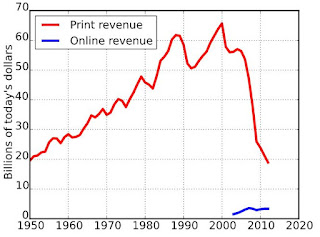
Of all the revolutions that we are currently living, technology is the most promising one. It has killed industries , obliterated professions , and elevated the standard of living for those consumers who have participated in the bonanza. Technology (or more specifically, the internet) has disrupted the taxi monopoly on urban transportation, broken the chokehold of the prescription eyeglasses industry, and more generally, commoditized information .  But, if the internet has destroyed the margins of information dispersion companies... Sad news for journalism majors :( ... and made many disappear... more sad news for journalism majors :( Why is it, then, that the internet, which fundamentally is a revolutionary way to distribute (and potentially instill) knowledge, has not contributed to the commoditization of the Educational function of the University (whose mission precisely is to distribute and instill knowledge)? The answer, as certain South Afr...

Algo-calyptic Armaggedon

There seems to be hysteria these days around AI and algorithm-based consumption. The algorithmic economy  threatens to bring to the realm of the tangible that totem of economic dogma called the "invisible hand." Computers are finally linking --through big data-- individuals' behavior with algorithms that sort them, allowing machines to predict reactions: the "invisible hand" materializes(!). Nothing like predicting human conduct to be able to make money. That damned watch I dared to search for 3 weeks ago in a moment of stupid leisure has haunted me everywhere I go on the internet. Please, stop it Google. I'm not buying it. The idea that we are just soft machines  is a fascinating one. It feeds the collective dread of an algorithmically-dominated Armageddon, making people fret about a time in the not-so-distant future when we will decide nothing for ourselves, and when everything will be dictated by an algorithm --surreptitiously creating the illusion of  ...

The Battle for your Mind

Image
It appears that "hacking" is in the news  lately. Often . And I mean,  big time . The meaning of the word is almost unanimously attached to an act of law-breaking with the clear, malicious intent of stealing someone else's property. But not everyone  grants this buzzword a bad meaning, no. The Zuck is famous for turning its meaning around to make it appear something idealistic --grandiose even. "Hacking," he says, is the trade of heroic, altruistic visionaries who are doggedly determined to make the world a better place --for example, by attempting to  bring internet to the entire Saharan Africa. Forget about the fact that starving people in poor countries and desolate refuge camps can't sustain on a kilobyte diet. Internet, the wacky  technorati  elite trumpets, is to become the end-all-be-all of human prosperity. Hacking, the way I understand it, is gaining access to the inner workings ("the code") of something to be able to manipulate it fo...

The Matrix has you

We hear it all the time: the Internet is becoming more and more important in our lives. We read news on it, we socialize , shop, bank , and get an increasing share of our entertainment from it. A whole parallel cyber-universe coexists with the brick-and-mortar (often more boring) reality we brave every morning we step out of our beds. The Wachowsky brothers were not that crazy after all. We choose to live in a computer-generated reality -- a "Matrix" called Internet. Our Facebook self is nothing but our own residual self image --the "Neo" version of ourselves. One would think the parallelisms between cyberspace and real life should extend to many more areas. If there is a marketplace in cyberspace -where you can get anywhere from a prostitute to a Bentley- and a bunch of social networks where humans interact -some even find their soul mates-, the same natural/legal rights and social institutions that underpin growth and stability in the brick-and-mortar world ...