Posts

Showing posts with the label Social Networks

Storytime

Image
We're instinctive animals. We act in accordance to what we feel: anger, happiness, compassion, pain. Your body is an evolution-optimized "soft machine"  whose actions can be traced and explained by specific emotions.  You are cold? You get a blanket. The pain your nerves communicate to your brain prompts you to act and look for warmth. You're angry because somebody flipped you off on your commute to work? Your return the gesture, or even escalate by cutting him/her off at the first chance.   Emotion begets actions. We are slaves to the whims of our feelings. Entire religions and eastern traditions are built around the concept of achieving control over what we feel and emote. Nobel prizes are given to those who invent  new branches of knowledge which merge psychology and economics (“behavioral economics”), based on the idea that our emotions makes us act stupidly.  This is evidently a huge blind spot in all of us. A vulnerability that's been exploite...
Take the red pill

Image
I am not really sure if we really appreciate the true brilliance of the The Wachowsky brothers'  The Matrix . Its prescience was uncanny. In 1999, they dreamed up a world in which humans were harvested for their energy, for the benefit of machines. A sentient, all-encompassing machine--originally created by humans-- developed a sense of self-interest and built an illusory world available solely to the sensory perceptions of their captive slaves, who were entertained by such illusion and kept in apocalyptic-looking pods --hooked-up to devices that fed the machine with energy. "Reality" was simply too shiny. Too engaging. Too real to look away from. You needed to take the red pill to wake up . At the time --and up until very recently-- my idea of it all was that The Matrix was just a very sophisticated criticism of Capitalism. A " call to arms " of sorts to all nine-to-fivers who despised their monotonous jobs, felt utterly empty and purposeless, and desperate...

Mind the Gap

Image
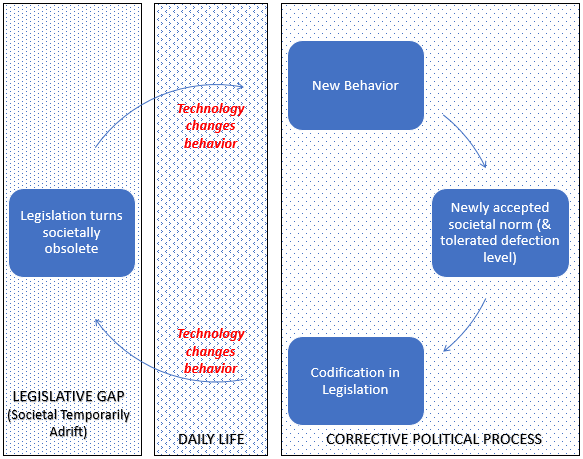
Societies are an agreed-upon set of collective norms. A bet on everyone else's behavior to cooperate for the benefit of all. Although that set is not really... set . Like any human construct, they evolve. Interact with their environment. They change course when faced with influencing factors. Also, not every member of society fulfills their agreement. Some people invariably defect (misbehave), and the collective agrees that some level of defection is just not worth getting that much worked-up about. Just ask San Franciscans  about car break ins. Or  John Oliver  about robocalls .  Behind all this lies an iterative process. After society determines it can't tolerate certain defection level, it pressures governmental institutions to tighten its grip via the codification of punishments directed at them damn defectors. New laws criminalizing the deleterious behavior arrive. Defection (hopefully) diminishes.  The iterative process is not only about fig...

Low Red Cell Count

Image
Trust is the lifeblood that keeps societies alive, and by extension, what keeps the lives of hundreds of millions of people from harm. Without trust, societies can't exist. You need to trust that your employer will honor your salary, your bank to keep your money safe, and your Angie's list-sourced plumber to not show up with an ax to chop your head off. At the beginning of human existence, morals and reputation within the tribe represented a kind of currency of value, which was used to interact cooperatively and constructively to further the shared goals of survival. Trust, it can be argued, is behind human's success on this planet. As hunter-gatherer groups grew in size, our brains' mental capacities to assimilate and process trust maxed out. After all, keeping a mental score of the number of people that have betrayed you in the tribe reaches a limit (called the  Dunbar number ) fairly quickly. Due to this mental ceiling, humankind demographic growth was constricted...

The Art of the Nudge & The Rock Star Presidency

Image
Reality is what you perceive it to be. That much is obvious. We were bred this way by nature, and it is thanks to this ability to react to our individually perceived reality  that we are where we are as a species, for better or worse. That we are social animals is no surprise, either. We pick teams , pledge allegiances to like-minded groups, mimic the behavior of other people, and fall for mental shortcuts  that inform our decisions ( many times to our own detriment ). That social networks exploit these bad habits of ours is also exceedingly clear by now. But what about Governments? They don't necessarily need armies of patriotic trolls hawking dissident Facebook users to shape the collective discourse. Forget for now about the fact that Facebook is literally teaching the authoritarian governments of institutionally weak countries how to harness the evil powers of the network to sharpen their manipulation skills and their grip on society.    All Governments ne...

War 2.0

Wars are no longer waged on the ground. Or at least not just there. Conquering Invasions are not necessary when what you need to  conquer is the mind . Inflicting human losses via bullets is so counterproductive. Dead people can't contribute to the monetization of online content, after all. Corpses can't be  groomed online nor harvested for profit , you see. Now, battles are waged in the ethereal realm of the internet. It is there where ideas spawn, linger, are nurtured,  get amplified , and most importantly, morph into radicalization. The decadence of traditional media (with the  disintegration of its grip  on the collective conscience), has given way to this new (and dynamically fluent) status quo: people get their daily dose of information from the internet. They interact with each other, and experience an increasingly broader share of their daily lives there. Physical interaction no longer exists. The public square is now dead. And so is the mall ....

Don't Fly On Autopilot

As inhabitants of this universe, we have always evolved within a time continuum. Entropy is inexorable . Time inevitably advances in a single direction. As a consequence, our development as living beings in this planet has always been ruled by the perception of causality. One event happens, and it influences a subsequent event. A linkage between past and present can be drawn. And it can be drawn because this trial-and-error mechanism called evolution settled in our brains after thousands of iterations --in a masterfully choreographed case of survivorship bias -- this form of knowledge acquisition. The linkages have a mundane name: rules. Or what evolutionary psychologists like to fancily call  heuristics . And they have a simple reason to exist: so the brain processes information in the most energy-efficient manner . These have always been the rules of engagement --and we can't consciously process reality any other way. They shaped --nay,  created--  us E...

The Search for a New Order

The search for a new social and economic world order continues in the middle of all this madness. At least in my head. Growth and its power-law dynamics brought us to a place where the losers can't hold it together any longer. Rage engulfs  the developed world. Irrationality  reigns supreme . Capitalism (coupled with rule of law and property rights ) had provided the avenue to exercise our self-determination. The principle that material success is entirely (or at least mostly) dependent on our effort had proven a quasi-religious mantra for many. And it was alluring. More than that: self-vindicating . The idea that I'm the architect of my destiny and that nothing can hold me back can be an inebriating, hypnotizing force that arms us with untold amounts of discipline and resolve to over-perform. Forget for now about the fact that that over-performance can be easier to achieve in the fast lane   of that avenue. Or that a government has to build the actual ave...

The Rise of The Tribe

" Postmodernism " started it all. That "liberating" doctrine initiated the quest for the exaltation of the self. I'm entitled to my own opinion. I will not be a conformist. Look how passionate I am!  Doing things out of anger (er, I mean, out of "passion") started being more important than accepting objective reality, because no one wanted to be the dull robot who followed the rules. Individualism --uniqueness-- was cool . There used to be a time when we accepted that we couldn't assimilate all the information available around us (because, logically, we couldn't  experience it all  for ourselves), so we outsourced that knowledge to a credible source. We took it from them, at face value. We trusted. But oh, no. Postmodernist gave us agency. We now know better. Our guts tell us so. With time and the inflated prominence of one's (and most importantly, one's opinions)  worth came the disdain for the un witnessed fact, and the privile...

The Disruption of Truth

Technology has finally broken the Media's choke-hold of Society's Collective Conscience  and I don't know if that is a good thing or not. Truth and fact have been disrupted, making way for the rule of emotion and intuition over rationality and knowledge. I don't think The Zuck ever stopped to think about the true consequences of making people more connected all over the world. But the reality is now in the open, and we can all attest to it now:  Interconnectedness drives instability . What started with the seemingly innocuous (and commendable) goal allowing people to share baby pictures among family members morphed into allowing activists to organize political demonstrations. And then  giving Alt-Right trolls a megaphone . Goading is so much fun! Until the reaction is border militias with elite-training itching to kill imaginary ISIS invaders at the SW border with very non-imaginary AR15s. Actual bloody revolutions still rage, efficiently kindled by the smartpho...

Algo-calyptic Armaggedon

There seems to be hysteria these days around AI and algorithm-based consumption. The algorithmic economy  threatens to bring to the realm of the tangible that totem of economic dogma called the "invisible hand." Computers are finally linking --through big data-- individuals' behavior with algorithms that sort them, allowing machines to predict reactions: the "invisible hand" materializes(!). Nothing like predicting human conduct to be able to make money. That damned watch I dared to search for 3 weeks ago in a moment of stupid leisure has haunted me everywhere I go on the internet. Please, stop it Google. I'm not buying it. The idea that we are just soft machines  is a fascinating one. It feeds the collective dread of an algorithmically-dominated Armageddon, making people fret about a time in the not-so-distant future when we will decide nothing for ourselves, and when everything will be dictated by an algorithm --surreptitiously creating the illusion of  ...

Closer to the Clouds

Are we all lazy creatures? Some would say we always look for shortcuts to obtain what we want --even in the most disciplined version of ourselves. The path of least resistance defines our every move. The behavior goes deeper than what we see in our penchant to become couch potatoes. The brain also is always looking for ways to do the same tasks in the most efficient (effortless) way possible. Amblyopia  is an example of the brain turning off the visual signal in one eye, choosing to overdevelop the other to compensate the loss of vision in the first one. There have been reported cases of people losing hearing in one ear without any apparent reason while at the same time overdeveloping the other ear. When the brain realizes that it can accomplish the same task with less resources, it appears it decides to shut down redundancies. But what happens when a redundancy in the brain is created by an external agent? Some discovery -fire-, some tool -utensils-, some technology created for...

Membership has its Privileges (at a cost)

Image
How important is it to feel like you belong? To many of us, very important. We are social animals that constantly feel the need to be accepted . Religion, sports teams fan clubs, political parties. All examples of groups of people that share something in common. Networks of people. The concept goes beyond human association based on interests or values. Networks are formed around the use of common instruments: languages, gadgets, credit cards. Why join a network? Because you benefit from the fact that other people belong to that very same club. As a non-native English speaker, you learn English because the world of international business speaks English, not Russian, Greek or Arabic. You get a Visa Card instead of a Discover or Diners Club because you want to have access to the biggest network of POS in the world (87% of merchants worldwide accept it). You buy a gasoline-powered vehicle instead of one using Natural Gas because you want access to the well-established network of gas...

The Matrix has you

We hear it all the time: the Internet is becoming more and more important in our lives. We read news on it, we socialize , shop, bank , and get an increasing share of our entertainment from it. A whole parallel cyber-universe coexists with the brick-and-mortar (often more boring) reality we brave every morning we step out of our beds. The Wachowsky brothers were not that crazy after all. We choose to live in a computer-generated reality -- a "Matrix" called Internet. Our Facebook self is nothing but our own residual self image --the "Neo" version of ourselves. One would think the parallelisms between cyberspace and real life should extend to many more areas. If there is a marketplace in cyberspace -where you can get anywhere from a prostitute to a Bentley- and a bunch of social networks where humans interact -some even find their soul mates-, the same natural/legal rights and social institutions that underpin growth and stability in the brick-and-mortar world ...