Posts

Showing posts with the label Keynes

Don't Be Such A Downer.

I've been told that I am a negative person. And of course, I don't think I am. My motivated reasoning kicks in and immediately tells me that I can't be that negative . But then I stop to think about it and realize that I might be,  after all . Always looking at the phone for the news-break --which are generally negative. Sharing the latest story about a potential pandemic , or about locust swarms blanketing africa , or about the potential WWIII-triggering assassination of an Iranian Commander . Or about the Puerto Rico earth-quake . Reflecting upon that, I've settled upon a couple of ideas. Yes, I pay more attention to the negative stuff. And I share it as soon as I can (at least the significant parts). But I don't think that makes me negative . I think that makes me human. I am, just like everyone else, equipped with a bunch of mental quirks that make me (and you) gravitate towards anything threatening around you. When we are reminded of all the progress that ...
Take the red pill

Image
I am not really sure if we really appreciate the true brilliance of the The Wachowsky brothers'  The Matrix . Its prescience was uncanny. In 1999, they dreamed up a world in which humans were harvested for their energy, for the benefit of machines. A sentient, all-encompassing machine--originally created by humans-- developed a sense of self-interest and built an illusory world available solely to the sensory perceptions of their captive slaves, who were entertained by such illusion and kept in apocalyptic-looking pods --hooked-up to devices that fed the machine with energy. "Reality" was simply too shiny. Too engaging. Too real to look away from. You needed to take the red pill to wake up . At the time --and up until very recently-- my idea of it all was that The Matrix was just a very sophisticated criticism of Capitalism. A " call to arms " of sorts to all nine-to-fivers who despised their monotonous jobs, felt utterly empty and purposeless, and desperate...

Thoughts on Capitalism

Image
You know there's a problem with Capitalism when Ray Dalio, a guy who has made billions in the financial markets is saying that capitalism will explode into an armed revolution if we don't reform it. You know there's a problem with Capitalism when the Business Roundtable announces that they've formally and officially renounced shareholder primacy . If the guys who stand to benefit the most from Capitalism are calling for reform, it is definitely indication that the fire has reached the backyard. Capitalism is akin to nature. Its natural selection process is the free market, in which competition selects winners over losers. Just like Evolution uses natural selection to arrive at fitter species, Capitalism uses the market to arrive at  "fitter citizens" ( wealthy citizens). But Evolution does not know about ethics (it is a mental construct devised by society, after all), nor does it carry a specific purpose (it isn't teleological). Here is where Capita...

I Think I'm Turning Japanese

Image
You and I are going to die. That much is certain. And --hopefully not much-- before that, we will burden our society and our family with the responsibility of taking care of us. Historically, the burden was carried by the children. That is why many societies have instilled in their members (I can't think of one that doesn't) the value of respect towards their elders --a societal self-preservation mechanism that allows the ageing to finally collect a loan they originally extended to society in the form of productivity when they were young. Be it directly (via familial care) or indirectly (via tax collection), that debt is paid for by the work and effort of those coming behind --kin or not. Younger generations are thus, by definition, cursed (or blessed) by the genealogical accident that assigned them cosmic responsibility of their older generation. Their collective agency with regards to their generational responsibility is stripped from them the same way it was also stripped ...

Mind the Gap

Image
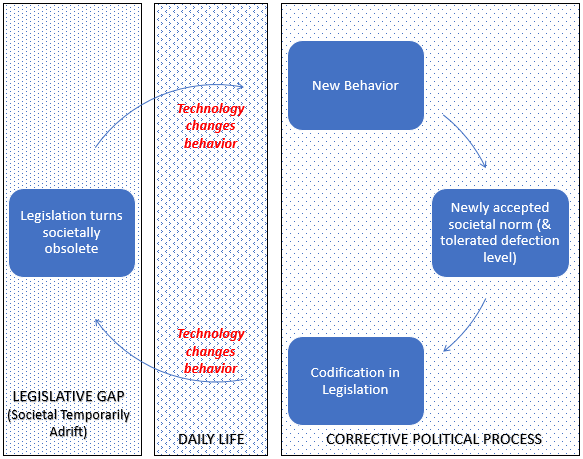
Societies are an agreed-upon set of collective norms. A bet on everyone else's behavior to cooperate for the benefit of all. Although that set is not really... set . Like any human construct, they evolve. Interact with their environment. They change course when faced with influencing factors. Also, not every member of society fulfills their agreement. Some people invariably defect (misbehave), and the collective agrees that some level of defection is just not worth getting that much worked-up about. Just ask San Franciscans  about car break ins. Or  John Oliver  about robocalls .  Behind all this lies an iterative process. After society determines it can't tolerate certain defection level, it pressures governmental institutions to tighten its grip via the codification of punishments directed at them damn defectors. New laws criminalizing the deleterious behavior arrive. Defection (hopefully) diminishes.  The iterative process is not only about fig...

Low Red Cell Count

Image
Trust is the lifeblood that keeps societies alive, and by extension, what keeps the lives of hundreds of millions of people from harm. Without trust, societies can't exist. You need to trust that your employer will honor your salary, your bank to keep your money safe, and your Angie's list-sourced plumber to not show up with an ax to chop your head off. At the beginning of human existence, morals and reputation within the tribe represented a kind of currency of value, which was used to interact cooperatively and constructively to further the shared goals of survival. Trust, it can be argued, is behind human's success on this planet. As hunter-gatherer groups grew in size, our brains' mental capacities to assimilate and process trust maxed out. After all, keeping a mental score of the number of people that have betrayed you in the tribe reaches a limit (called the  Dunbar number ) fairly quickly. Due to this mental ceiling, humankind demographic growth was constricted...

The Human Super Weapon

Image
The human brain is a marvelous adaptation. More than that. It's our super weapon. If we measured its capacity in bytes, it would be equivalent to 2.5 petabytes (or 2.5 million Gigabytes). For those who want to measure it in more palatable units, that's roughly 3 million hours of TV shows . No wonder why it's such an energy suck : with only 3% of our body mass, it uses 20% of the body's total blood supply and 25% of its oxygen. Our brain is what made us competitive in nature, what's allowed us to increase our standard of living, and what facilitated the domination of the elements for the exclusive and selfish benefit of our kin. And maybe, too, for the benefit of one or two super lucky chosen species that we like over the rest of the animal kingdom because we happened to breed them to our liking. But before we dominated the planet, natural selection was this randomized process of trial and error in which each species could get better generation after gener...

Emotional Times

Image
It recently dawned on me that Governments no longer govern people. They govern opinions. These days, people don't vote. Emotions do. Yes, a hand might ultimately pull the lever at the ballot box, but it is the emotion inside that voter's heart which sets in motion the wheels of any electoral backlash. Maybe there was once a Utopian time (I can't quite pinpoint it; go ask a historian) in which the electorate exercised a conscious, effortful mental evaluation of policy positions of candidates and exercised their democratic power with the sober responsibility it theoretically entails. What is clear now, is that these are not  those times. The Tsunami of information that has come with media's atomization (and later on with the internet), coupled with the increase in education worldwide, has created an environment in which any   narrative can be built and backed up by data. Graph from GapMinder. Random selection of countries. ALL increasing their attainment levels. ...

Parasites. Parasites Everywhere!

You could say that parasites are evil creatures. They're selfish, manipulative, and insidious. When they infect a host, they hope they don't kill it while they live within (since killing the host would mean killing itself). In that sense, parasites are tangentially symbiotic with the living things they infect. They existentially need a propagator --a host to help them spread themselves as efficiently as possible. Parasites can even take reign of the infected being's behavior for their own benefit: Sneezing is the common cold virus' effective way to propagate itself. Cuddling is the way an infectious virus makes kids look for closeness, so the infection jumps easily to the next host. The Gordian worm manipulates the brain of an infected cricket into jumping into water in order for the worm to mate. We rarely stop to think about this, but interwoven ideas (Narratives) are parasitic, evil body-less "creatures" too. Like parasites, Narratives can't surviv...

The Art of the Nudge & The Rock Star Presidency

Image
Reality is what you perceive it to be. That much is obvious. We were bred this way by nature, and it is thanks to this ability to react to our individually perceived reality  that we are where we are as a species, for better or worse. That we are social animals is no surprise, either. We pick teams , pledge allegiances to like-minded groups, mimic the behavior of other people, and fall for mental shortcuts  that inform our decisions ( many times to our own detriment ). That social networks exploit these bad habits of ours is also exceedingly clear by now. But what about Governments? They don't necessarily need armies of patriotic trolls hawking dissident Facebook users to shape the collective discourse. Forget for now about the fact that Facebook is literally teaching the authoritarian governments of institutionally weak countries how to harness the evil powers of the network to sharpen their manipulation skills and their grip on society.    All Governments ne...

War 2.0

Wars are no longer waged on the ground. Or at least not just there. Conquering Invasions are not necessary when what you need to  conquer is the mind . Inflicting human losses via bullets is so counterproductive. Dead people can't contribute to the monetization of online content, after all. Corpses can't be  groomed online nor harvested for profit , you see. Now, battles are waged in the ethereal realm of the internet. It is there where ideas spawn, linger, are nurtured,  get amplified , and most importantly, morph into radicalization. The decadence of traditional media (with the  disintegration of its grip  on the collective conscience), has given way to this new (and dynamically fluent) status quo: people get their daily dose of information from the internet. They interact with each other, and experience an increasingly broader share of their daily lives there. Physical interaction no longer exists. The public square is now dead. And so is the mall ....

Don't Fly On Autopilot

As inhabitants of this universe, we have always evolved within a time continuum. Entropy is inexorable . Time inevitably advances in a single direction. As a consequence, our development as living beings in this planet has always been ruled by the perception of causality. One event happens, and it influences a subsequent event. A linkage between past and present can be drawn. And it can be drawn because this trial-and-error mechanism called evolution settled in our brains after thousands of iterations --in a masterfully choreographed case of survivorship bias -- this form of knowledge acquisition. The linkages have a mundane name: rules. Or what evolutionary psychologists like to fancily call  heuristics . And they have a simple reason to exist: so the brain processes information in the most energy-efficient manner . These have always been the rules of engagement --and we can't consciously process reality any other way. They shaped --nay,  created--  us E...