Posts

Showing posts with the label Technology

Take the red pill

Image
I am not really sure if we really appreciate the true brilliance of the The Wachowsky brothers'  The Matrix . Its prescience was uncanny. In 1999, they dreamed up a world in which humans were harvested for their energy, for the benefit of machines. A sentient, all-encompassing machine--originally created by humans-- developed a sense of self-interest and built an illusory world available solely to the sensory perceptions of their captive slaves, who were entertained by such illusion and kept in apocalyptic-looking pods --hooked-up to devices that fed the machine with energy. "Reality" was simply too shiny. Too engaging. Too real to look away from. You needed to take the red pill to wake up . At the time --and up until very recently-- my idea of it all was that The Matrix was just a very sophisticated criticism of Capitalism. A " call to arms " of sorts to all nine-to-fivers who despised their monotonous jobs, felt utterly empty and purposeless, and desperate...
Mind the Gap

Image
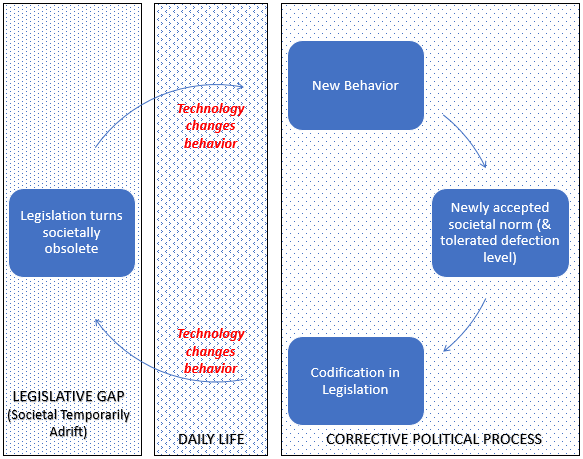
Societies are an agreed-upon set of collective norms. A bet on everyone else's behavior to cooperate for the benefit of all. Although that set is not really... set . Like any human construct, they evolve. Interact with their environment. They change course when faced with influencing factors. Also, not every member of society fulfills their agreement. Some people invariably defect (misbehave), and the collective agrees that some level of defection is just not worth getting that much worked-up about. Just ask San Franciscans  about car break ins. Or  John Oliver  about robocalls .  Behind all this lies an iterative process. After society determines it can't tolerate certain defection level, it pressures governmental institutions to tighten its grip via the codification of punishments directed at them damn defectors. New laws criminalizing the deleterious behavior arrive. Defection (hopefully) diminishes.  The iterative process is not only about fig...

War 2.0

Wars are no longer waged on the ground. Or at least not just there. Conquering Invasions are not necessary when what you need to  conquer is the mind . Inflicting human losses via bullets is so counterproductive. Dead people can't contribute to the monetization of online content, after all. Corpses can't be  groomed online nor harvested for profit , you see. Now, battles are waged in the ethereal realm of the internet. It is there where ideas spawn, linger, are nurtured,  get amplified , and most importantly, morph into radicalization. The decadence of traditional media (with the  disintegration of its grip  on the collective conscience), has given way to this new (and dynamically fluent) status quo: people get their daily dose of information from the internet. They interact with each other, and experience an increasingly broader share of their daily lives there. Physical interaction no longer exists. The public square is now dead. And so is the mall ....

The Age Warfare Era Has Officially Begun

Image
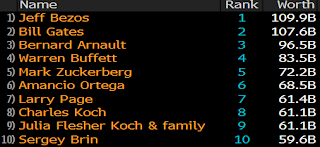
Economics has always assumed that Capital (K) and Labor (L) are complementary factors of production (Y). Look how pretty and sophisticated this economic abstraction looks Meaning, roughly, that you can't produce something with K if you don't have a bunch of people (L) pulling K's levers and buttons. Alas. As is the case with many things economists have cooked up in their simplistic, impossibly abstract assumptions, this is not even close to reality. K and L are fundamentally different. L is human; K isn't. K might be owned by a human (the Capitalist), but K does not function the same way as L does. K doesn't go to restaurants. K doesn't buy gifts for its family on Christmas. Any income K receives, it recycles it back into itself, compounding its power; into reinvestment, and away from restaurant dinners and Christmas shopping for the family because, well, K doesn't have a family. There used to be a time in the past when K and L formed a succe...

Don't Let Your Domino Fall Alone

Our mind is a surreptitious and tyrannical ruler. We may have a sense of self consciousness (some of us a very  inflated one), but so many vestigial processes rule our brains' functioning that we fail to fathom how little room we actually have to exercise our freedom. No organ in our body has been more shaped by the "trial-and-error" process of evolution than our brain. Our irrationality, biases, fears, addictions, and phobias are all somehow anchored in an ancient and obscure vestige behavior that allowed our ancestors thrive past through harsh conditions. Don't know about that gag reflex that prevents you from drinking perfectly  safe purified sewage/toilet water? There's a reason we innately find excrement and fetid matter gross. Couple thousand generations ago our brains had to incorporate this preservation mechanism to avoid dysentery, cholera, and many more nasty digestive-born diseases. Ever heard of trypophobia , that irrational repulsive reflex t...

Algo-calyptic Armaggedon

There seems to be hysteria these days around AI and algorithm-based consumption. The algorithmic economy  threatens to bring to the realm of the tangible that totem of economic dogma called the "invisible hand." Computers are finally linking --through big data-- individuals' behavior with algorithms that sort them, allowing machines to predict reactions: the "invisible hand" materializes(!). Nothing like predicting human conduct to be able to make money. That damned watch I dared to search for 3 weeks ago in a moment of stupid leisure has haunted me everywhere I go on the internet. Please, stop it Google. I'm not buying it. The idea that we are just soft machines  is a fascinating one. It feeds the collective dread of an algorithmically-dominated Armageddon, making people fret about a time in the not-so-distant future when we will decide nothing for ourselves, and when everything will be dictated by an algorithm --surreptitiously creating the illusion of  ...

The Subsistence Trap

Technology has always been feared and revered at the same time. It has always been this dual destructive/liberating boogieman/hero that divides people. And with good reason. The way it eases human life can be addictive --sometimes pathologically so. But also disruptive (the word has been used --and abused --  ad-nauseam lately). We know what happens when new things disrupt the way we live our lives. Our conservatism bias (that miniature devil who sits on our shoulder and keeps us stuck at the same jobs for years and years) fights the heck out of it . These days there's been a plethora of analyses about the way technology will reshape  jobs around the world. The topic is ripe with speculation. Will it create an army of destitute willing to wage revolutions to fight to get their stolen livelihoods back? Will it save us from the planet's resource depletion ? Will it allow for people to adapt  and learn new skills to complement the technologies that will automatize (i.e. ...

The Battle for your Mind

Image
It appears that "hacking" is in the news  lately. Often . And I mean,  big time . The meaning of the word is almost unanimously attached to an act of law-breaking with the clear, malicious intent of stealing someone else's property. But not everyone  grants this buzzword a bad meaning, no. The Zuck is famous for turning its meaning around to make it appear something idealistic --grandiose even. "Hacking," he says, is the trade of heroic, altruistic visionaries who are doggedly determined to make the world a better place --for example, by attempting to  bring internet to the entire Saharan Africa. Forget about the fact that starving people in poor countries and desolate refuge camps can't sustain on a kilobyte diet. Internet, the wacky  technorati  elite trumpets, is to become the end-all-be-all of human prosperity. Hacking, the way I understand it, is gaining access to the inner workings ("the code") of something to be able to manipulate it fo...

Closer to the Clouds

Are we all lazy creatures? Some would say we always look for shortcuts to obtain what we want --even in the most disciplined version of ourselves. The path of least resistance defines our every move. The behavior goes deeper than what we see in our penchant to become couch potatoes. The brain also is always looking for ways to do the same tasks in the most efficient (effortless) way possible. Amblyopia  is an example of the brain turning off the visual signal in one eye, choosing to overdevelop the other to compensate the loss of vision in the first one. There have been reported cases of people losing hearing in one ear without any apparent reason while at the same time overdeveloping the other ear. When the brain realizes that it can accomplish the same task with less resources, it appears it decides to shut down redundancies. But what happens when a redundancy in the brain is created by an external agent? Some discovery -fire-, some tool -utensils-, some technology created for...