Posts

Showing posts with the label Society

Todos Somos Conservadores

Tú y yo no somos mas que diminutas hormigas, peleando contra el desorden de nuestro alrededor, en medio de un universo que tiende al caos. Desde nuestro insignificante y unilateral punto de vista (el humano), siempre estamos tratando de minimizar sorpresas. Ese fue el cerebro que la evolución nos regaló.    Y cuando las sorpresas aparecen,   aprendemos , esperando aplicar lo aprendido en nuestra próxima interacción con nuestro entorno, con la esperanza de sobrevivir. Bueno, tal vez no seamos "nosotros" como tal, sino nuestros genes, porque nosotros en realidad solo somos el vehículo que nuestros genes usan para perpetuarse a la posteridad.  Si tan solo nuestra lucha contra el desorden fuera exenta de consecuencias. Cada vez que tratamos de reducir el desorden a nuestro alrededor (de reducir entropía), para reacomodar nuestro ambiente de tal manera que sea menos hostil para nosotros, en realidad estamos incrementando el desorden (la entropía) en el universo en general...
Don't Be Such A Downer.

I've been told that I am a negative person. And of course, I don't think I am. My motivated reasoning kicks in and immediately tells me that I can't be that negative . But then I stop to think about it and realize that I might be,  after all . Always looking at the phone for the news-break --which are generally negative. Sharing the latest story about a potential pandemic , or about locust swarms blanketing africa , or about the potential WWIII-triggering assassination of an Iranian Commander . Or about the Puerto Rico earth-quake . Reflecting upon that, I've settled upon a couple of ideas. Yes, I pay more attention to the negative stuff. And I share it as soon as I can (at least the significant parts). But I don't think that makes me negative . I think that makes me human. I am, just like everyone else, equipped with a bunch of mental quirks that make me (and you) gravitate towards anything threatening around you. When we are reminded of all the progress that ...

Take the red pill

Image
I am not really sure if we really appreciate the true brilliance of the The Wachowsky brothers'  The Matrix . Its prescience was uncanny. In 1999, they dreamed up a world in which humans were harvested for their energy, for the benefit of machines. A sentient, all-encompassing machine--originally created by humans-- developed a sense of self-interest and built an illusory world available solely to the sensory perceptions of their captive slaves, who were entertained by such illusion and kept in apocalyptic-looking pods --hooked-up to devices that fed the machine with energy. "Reality" was simply too shiny. Too engaging. Too real to look away from. You needed to take the red pill to wake up . At the time --and up until very recently-- my idea of it all was that The Matrix was just a very sophisticated criticism of Capitalism. A " call to arms " of sorts to all nine-to-fivers who despised their monotonous jobs, felt utterly empty and purposeless, and desperate...

Mind the Gap

Image
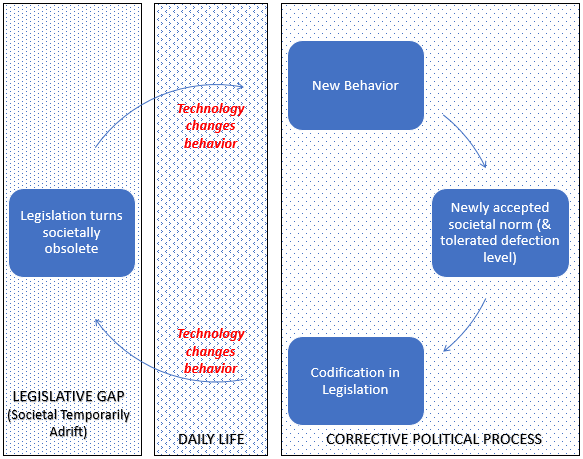
Societies are an agreed-upon set of collective norms. A bet on everyone else's behavior to cooperate for the benefit of all. Although that set is not really... set . Like any human construct, they evolve. Interact with their environment. They change course when faced with influencing factors. Also, not every member of society fulfills their agreement. Some people invariably defect (misbehave), and the collective agrees that some level of defection is just not worth getting that much worked-up about. Just ask San Franciscans  about car break ins. Or  John Oliver  about robocalls .  Behind all this lies an iterative process. After society determines it can't tolerate certain defection level, it pressures governmental institutions to tighten its grip via the codification of punishments directed at them damn defectors. New laws criminalizing the deleterious behavior arrive. Defection (hopefully) diminishes.  The iterative process is not only about fig...

Low Red Cell Count

Image
Trust is the lifeblood that keeps societies alive, and by extension, what keeps the lives of hundreds of millions of people from harm. Without trust, societies can't exist. You need to trust that your employer will honor your salary, your bank to keep your money safe, and your Angie's list-sourced plumber to not show up with an ax to chop your head off. At the beginning of human existence, morals and reputation within the tribe represented a kind of currency of value, which was used to interact cooperatively and constructively to further the shared goals of survival. Trust, it can be argued, is behind human's success on this planet. As hunter-gatherer groups grew in size, our brains' mental capacities to assimilate and process trust maxed out. After all, keeping a mental score of the number of people that have betrayed you in the tribe reaches a limit (called the  Dunbar number ) fairly quickly. Due to this mental ceiling, humankind demographic growth was constricted...

Don't Let Your Domino Fall Alone

Our mind is a surreptitious and tyrannical ruler. We may have a sense of self consciousness (some of us a very  inflated one), but so many vestigial processes rule our brains' functioning that we fail to fathom how little room we actually have to exercise our freedom. No organ in our body has been more shaped by the "trial-and-error" process of evolution than our brain. Our irrationality, biases, fears, addictions, and phobias are all somehow anchored in an ancient and obscure vestige behavior that allowed our ancestors thrive past through harsh conditions. Don't know about that gag reflex that prevents you from drinking perfectly  safe purified sewage/toilet water? There's a reason we innately find excrement and fetid matter gross. Couple thousand generations ago our brains had to incorporate this preservation mechanism to avoid dysentery, cholera, and many more nasty digestive-born diseases. Ever heard of trypophobia , that irrational repulsive reflex t...